
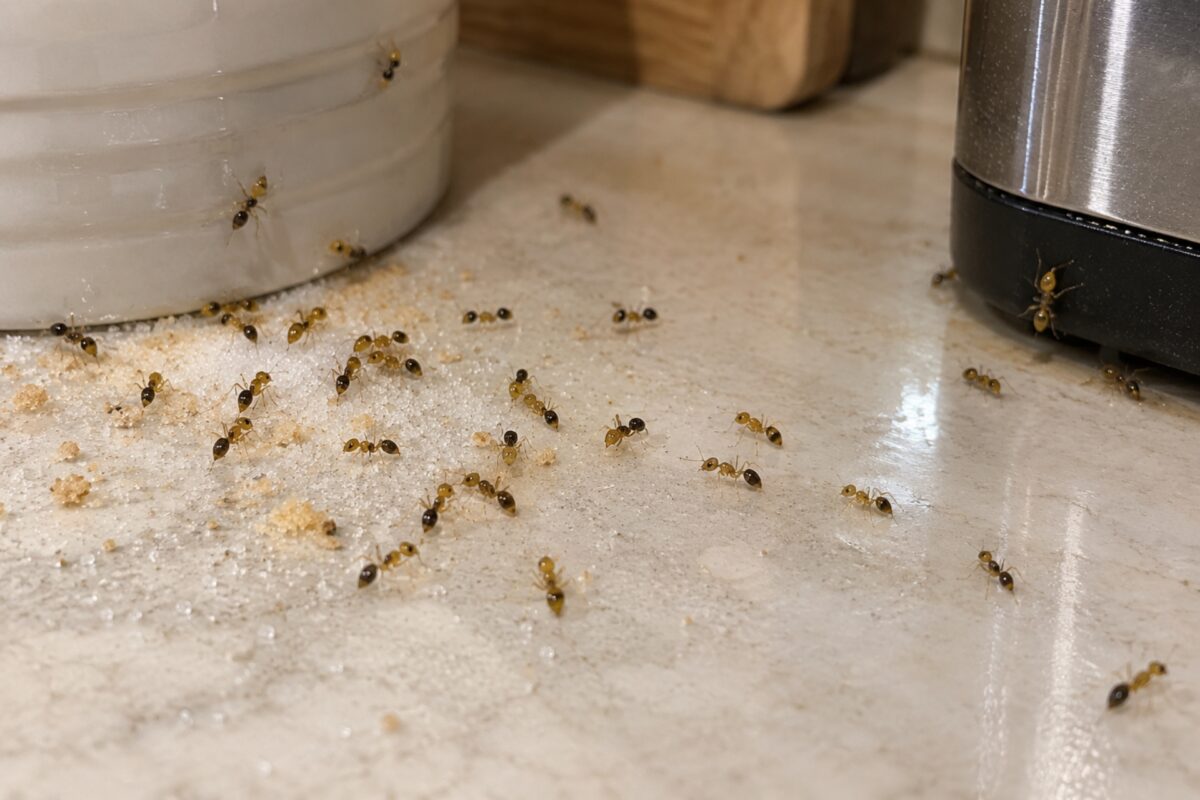
Ghost ants often return to Central Florida kitchens and bathrooms because these rooms give them dependable moisture, food, warmth, and protected routes through cabinets and walls. Wiping away a trail removes the ants you can see, but it may leave several connected nesting sites untouched. At Gato Lawn & Pest Control, we provide ant control in Orlando and Central Florida that begins with identifying the ant and tracing where it is traveling.
Their Size Makes the Source Difficult to Find
Ghost ants are extremely small. Their dark heads and pale bodies can make them look like moving specks, especially against light countertops, tile, and sinks. Their size allows them to follow narrow gaps around plumbing, cabinet seams, windows, baseboards, and electrical lines. A trail may disappear beneath a sink or behind a backsplash even though the nesting area is farther away.
The ants on a counter are workers searching for water or food. They can travel between indoor nesting sites and sheltered outdoor areas, so the place where you see them may be only one stop along a larger route. Following the trail in both directions is usually more helpful than treating the visible end of it.
Kitchens Provide Frequent Food Opportunities
A ghost ant colony can take advantage of very small amounts of food. Syrup around a cap, a drop of juice, crumbs beneath a toaster, residue inside a recycling bin, or pet food left out overnight may keep workers returning. Clean counters can still have attractive material in cabinet corners, beneath appliances, or along the edge where a counter meets the wall.
Ghost ants may also change what they feed on. A bait or household product that seemed attractive during one visit may receive little attention later. Randomly switching products can interrupt a trail without reaching the connected nesting sites. Species identification and careful placement are important when the goal is to affect the colony rather than the few workers in view.
Bathrooms Supply Water and Protected Paths
Bathrooms attract ghost ants even when no food is visible. Condensation, damp grout, a slow plumbing drip, moisture around a tub, and water left near a sink can support regular foraging. Plumbing openings also create protected paths into walls and cabinets.
Watch where the ants appear first. A line along the vanity has a different likely route than ants coming from a window frame or crossing the ceiling. Check for water beneath the sink, around the toilet connection, beside the tub, and near potted plants. Addressing a leak or persistent damp area removes a resource, although the existing colony may still require treatment.
Why Spraying the Trail Can Make Control Harder
Some small indoor ant species maintain multiple queens and connected nesting sites. When a colony is disturbed by a repellent spray, workers and queens may separate and establish additional groups in nearby spaces. The visible trail may vanish for a short time, then appear at another cabinet, sink, or room.
Surface spray also leaves the hidden ants untouched. Workers that would otherwise travel between food and the nesting area may die before they carry an appropriately selected bait back. Mixing household sprays, cleaners, and baits in the same small area can contaminate the bait or change the ants’ route.
If you have already applied a product, tell the technician what you used and where you placed it. That information helps explain a broken trail or a sudden change in where the ants are appearing.
What You Can Do Before Service
Leave a small section of an active trail undisturbed when practical so the technician can follow it. Remove exposed food, wipe sticky containers, rinse recyclables, and store pet food in a sealed container. Dry sinks and counters before bed, then note whether the ants return and where the line begins.
Avoid sealing every visible gap while ants are actively traveling through it. Closing one opening may send them to another route without resolving the nesting sites. A technician can identify useful maintenance steps after seeing how the ants are moving through the room.
Photos can also help when the trail is intermittent. Take a close picture with a familiar object nearby for scale, and record the room and time. Ghost ants may be mistaken for other tiny household ants, and the treatment choice depends on an accurate identification.
A Lasting Plan Starts With the Colony
Effective ghost ant control focuses on the colony network, its food and water sources, and the routes workers use. The plan may include carefully placed bait, targeted treatment in cracks or voids, exterior attention where ants are entering, and practical changes inside the home. Follow-up may be needed because several nesting sites can contribute to the same indoor problem.
If tiny ants keep returning to your Central Florida kitchen or bathroom, we can identify the species and build a plan around the way the ants are using your home. Contact Gato Lawn & Pest Control to schedule an inspection and show our technician every room where you have noticed trails.